Published by Coldwell Banker Caribe | August 2026 | Caribbean Coast Costa Rica
Estimated read time: 7 minutes | Category: Culture & Lifestyle
Walk into any bakery in Puerto Viejo during the last week of August and someone will be selling pan bon. Drive through Limón centro and you will pass schools rehearsing for a parade. On the 31st, the whole province stops for a national commemoration that most visitors have never heard of, and Afro-Caribbean culture in Costa Rica gets the public recognition it spent a century waiting for.
Costa Rica designates all of August as the Mes Histórico de la Afrodescendencia, formalized through Law 9526 in 2018. August 31 carries its own weight as the Día de la Persona Negra y la Cultura Afrocostarricense, a date the country adopted back in 1980. The date points to a specific moment in Black international history: the closing day of the first international convention of the Universal Negro Improvement Association at Madison Square Garden, August 31, 1920. Afro-Costa Rican organizers chose it deliberately, linking Limón to a movement that spanned the Atlantic world.
We work with buyers from the United States, Canada, Europe and increasingly from within Costa Rica, and the ones who settle here happily tend to share one trait. They arrive curious about the place as it actually is. This post is written for those buyers, and for anyone weighing a home in Puerto Viejo, Cahuita, Cocles, Playa Chiquita or Manzanillo who wants to know what the culture around that home is made of.
How Afro-Caribbean Culture Reached Costa Rica’s Caribbean Coast
The Afro-Caribbean presence in Limón traces mostly to the late nineteenth century, when workers came from Jamaica and other West Indian islands to build Costa Rica’s Atlantic railroad and later to work the banana plantations. They brought Protestant churches, English-language schools, Anancy stories, cricket, and a way of cooking that had already crossed the Atlantic once.
For decades, the community lived under legal and social restrictions that limited movement into the Central Valley and slowed access to citizenship. Full political and civil recognition came gradually through the twentieth century. That history explains something visitors often notice without being able to name it: the Caribbean coast built institutions, a language and a social fabric that owe very little to San José. The coast is a distinct cultural region within Costa Rica, and it knows it.
Understanding that shapes how you read the place. The small scale of Puerto Viejo and Cahuita, the reluctance to hand the shoreline over to large resort development, the strength of neighborhood associations: those are all downstream of a community that has spent 150 years defining its own terms.
Calypso Is a Living Tradition Here, and the State Says So
Cahuita is where Costa Rican calypso took root. Walter Gavitt Ferguson, born in 1919 and raised in Cahuita, wrote and recorded songs in Limonese English that documented daily life on the coast with humor and precision. He became the reference point for the entire genre.
In 2018, Costa Rica declared calypso limonense part of the country’s intangible cultural heritage through Law 9612. The same legislation established May 7 as the Día Nacional del Calipso Limonense, matching Ferguson’s birthday. That status routes public funding, school programming and festival support toward calypso musicians, which matters for a tradition carried mostly by people over sixty.
You can still hear it played live in Cahuita and Puerto Viejo, often by musicians who learned from people who learned from Ferguson. Calypso is what goes on at a family gathering, at a wake, at a school assembly in Cahuita. Visitors tend to find it once someone brings them along.
The Food Is the Most Accessible Way In
Caribbean cooking in Limón province runs on coconut milk, and once you notice that, the whole cuisine organizes itself.
Rice and Beans
Rice and beans on this coast simmers in coconut milk with thyme, garlic and a whole Panamanian chile that flavors the pot without setting it on fire. Costa Ricans elsewhere in the country use the name for a version of gallo pinto, which is a separate dish with a separate history. Sunday lunch across Limón province is built around it, usually alongside stewed chicken or fish. Many families still make it in a single pot on a wood fire.
Rondón
Rondón takes its name from the practice of “running down” whatever the kitchen has that day. Fish or seafood, yuca, plantain, breadfruit and tubers all go into coconut broth and cook slowly. Restaurants in Puerto Viejo and Manzanillo often need a day’s notice, since the dish rewards patience and rarely sits well.
Patí and Pan Bon
Patí is a folded pastry filled with spiced beef, close cousin to the Jamaican patty and sold from home kitchens and roadside windows all along the coast. Pan bon is a dark, dense sweet bread made with molasses and dried fruit, associated with Easter and with holidays generally, and it appears in force through August. National Geographic has covered the work Limón cooks put into recording these recipes and teaching them to the next kitchen.
Limonese English Counts as a Language of Its Own
Many families on the coast speak Limonese Creole English, sometimes called Mekatelyu, a name that comes from the phrase “make I tell you.” It descends from Jamaican Patois and carries its own grammar and vocabulary. Spanish runs school, government and most business on the coast, while tourism operates largely in Standard English. Between neighbors on a Saturday afternoon, you will hear Mekatelyu.
New arrivals sometimes assume the local English is broken Standard English and correct people, which lands badly. Linguists at the Universidad de Costa Rica have studied and documented the language for decades. Ask what a phrase means the next time you hear one you do not recognize. That small courtesy tends to change how quickly a neighborhood opens to you.
How to Celebrate: August 2026 Parade Dates and Events on the Caribbean Coast
Limón centro runs the largest programming. The Comité Cívico Cultural Étnico Negro de Limón has coordinated a month of activity for years under the banner “Back to Our Roots,” which typically includes a Caribbean food fair, panel conversations on community history, a fashion show featuring Afro-Caribbean design, and a Grand Parade through the main streets with floats, drum lines and dance groups. Costa Rica declared that parade part of its intangible cultural heritage in 2022.
Here is what remains on the calendar as of late August 2026.
| Date | Event | Where | Time |
| Fri Aug 28 | Caribbean gastronomy tasting | Public library, Limón centro | Daytime, confirm locally |
| Sun Aug 30 | Banda Nacional concert for Afro-Costa Rican culture | Museo Nacional, San José | 11:00 a.m. |
| Mon Aug 31 | Grand Gala Parade, “Back to Our Roots” | Starts at Parquecito Asís Esna, Puerto Limón, then through the city center | 11:30 a.m. |
| Mon Aug 31 | Banda Nacional de Limón concert | Limón centro | Confirm locally |
| Through Aug 31 | “Hilos de identidad,” exhibition of traditional Limón dress | Biblioteca Nacional, San José | Weekdays, 8:00 a.m. to 6:00 p.m. |
| Sat Sep 5 | Diáspora Parade | Parque Nacional, San José | 9:00 a.m. to 8:00 p.m. |
If You Are Going to the Grand Gala Parade on August 31
Leave Puerto Viejo by 8:00 a.m. The drive to Limón centro takes about ninety minutes on a clear day, and traffic on the 31st builds well before the parade starts. Park south of the center and walk in. Cash matters along the route, since the food comes out of home kitchens and nobody there runs a card reader. The music continues long after the last float passes, so plan on staying into the afternoon.
Smaller Events South of Limón
Puerto Viejo, Cahuita and the villages along the Manzanillo road hold their own events through the second half of the month, including school presentations, church services, community dinners and live music on the beach. These dates shift year to year and often get announced a week ahead on Facebook or on a hand-painted sign at the crossroads, so asking around town remains the reliable method. Anyone booking accommodation for the last week of August should reserve early.
Looking Ahead to October
Limón follows all of this with its Carnival around Día de las Culturas on October 12, a week of comparsas, concerts and a second major parade. The organizing committee publishes dates each year in late summer, so check before planning a trip around it.
Afro-Caribbean Culture in Costa Rica Is Part of What You Are Buying
Buyers who ask us about appreciation on this coast usually want infrastructure answers: the Route 32 improvements, the expansion at the Moín container terminal, fiber coverage in Cocles. Those all matter. Something harder to put in a spreadsheet belongs in the same answer.
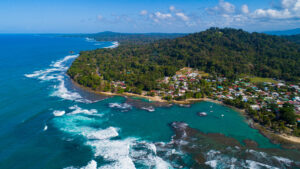
The Caribbean coast holds its value in large part because it has kept its character. Talamanca has no wall of high-rise towers. The beach towns remain walkable and low-slung. Protected zones cover a large share of the coastline, including Cahuita National Park and the Gandoca-Manzanillo Wildlife Refuge. Inland, the Bribri and Cabécar indigenous territories hold title that Costa Rican law makes inalienable. Community resistance to large-scale development has done as much to preserve the setting as any of those legal designations.
That preservation is what buyers are paying for, whether or not they frame it that way. A home in Playa Chiquita is worth what it is worth because the road to it still passes through tropical forest and small family businesses. Owners who understand that tend to protect it.
What Owners Can Do to Become Part of the Community
Hire locally when you build or renovate, at Limón wage rates. Make the pulpería near your house your default for groceries. Within your first month you should know the names of everyone living on your road. Owners who rent their property out can do a lot of good by briefing guests on where they have landed, from national park regulations to the fact that the beach dogs belong to somebody.
Show up on August 31. Watch the parade, put money into whatever people are cooking, and let yourself ask the obvious questions. Owners who keep doing this find that the coast returns the effort, in ways that range from better contractors to a real social life.
Frequently Asked Questions: Afro-Caribbean Culture in Costa Rica
What is celebrated in Costa Rica on August 31?
August 31 is the Día de la Persona Negra y la Cultura Afrocostarricense, Costa Rica’s national day recognizing Black Costa Ricans and Afro-Costa Rican culture. The country adopted the date in 1980, and it marks the closing of the first international convention of the Universal Negro Improvement Association, held at Madison Square Garden on August 31, 1920. The largest celebrations happen in Limón province, where a grand parade runs through the city center. Since 2018, Law 9526 has designated the entire month of August as the Mes Histórico de la Afrodescendencia, so programming runs across several weeks.
Is Puerto Viejo a good place to experience Afro-Caribbean culture?
Yes, and Cahuita and Limón centro will deepen the picture considerably. Puerto Viejo has grown into an international beach town with a large expat and tourist population, so the Afro-Caribbean presence there shares the street with surf shops and European-run restaurants. Cahuita sits twenty minutes north, holds much of its original village character, and gave Costa Rica its calypso tradition. Limón centro, an hour further along the coast road, houses the largest Afro-Costa Rican institutions and the biggest celebrations. Anyone serious about the culture should spend time in all three.
Do I need to speak Spanish to live on Costa Rica’s Caribbean coast?
You can get by in Puerto Viejo without Spanish because tourism runs on English, though the range of what you can do stays narrow. Spanish handles your legal paperwork, your immigration process, your utility accounts, your relationship with contractors and your children’s school. Many Afro-Costa Rican families on the coast also speak Limonese Creole English, which will help you socially. Most owners who settle here successfully arrive with basic Spanish and improve steadily. Local instructors in Puerto Viejo and Cahuita teach classes year-round.
Does the culture of the coast affect property values?
It does, indirectly and substantially. The community’s long-standing resistance to large-scale resort development has kept Talamanca low-density and walkable, and that scarcity of overbuilt shoreline is a large part of what buyers pay a premium for. Protected areas including Cahuita National Park and the Gandoca-Manzanillo refuge limit supply further, as do the Bribri and Cabécar territories inland. Buyers here consistently cite that preserved character as a reason they chose the coast, and it underpins demand for the properties that have it.
Can foreigners buy property in Puerto Viejo and Cahuita?
Foreigners can own titled property in Costa Rica outright, with the same rights as citizens, and no residency is required to buy. Two complications matter on this coast. Part of the shoreline falls inside the maritime terrestrial zone, where ownership works through concessions with different rules and restrictions on foreign participation. Separately, some inland parcels sit near or inside indigenous territories where sale to non-indigenous parties is prohibited. Confirm the legal status of any parcel with a Costa Rican attorney before you sign anything.
How Coldwell Banker Caribe Helps Buyers Settle Into the Caribbean Coast
Coldwell Banker Caribe is the only established Coldwell Banker franchise on Costa Rica’s Caribbean coast. Our agents live in Puerto Viejo, Cahuita and the surrounding communities, so the market knowledge we bring to a transaction is a product of daily life on this coast.
That local footing connects to the Coldwell Banker network across more than 44 countries, so buyers arriving from abroad work with a familiar name and standards they recognize, guided by people who can tell you where the road floods in November and which lots run into water trouble by March. We handle titled homes, beachfront property, jungle estates, boutique hotels and cabinas across Puerto Viejo, Cahuita, Cocles, Playa Chiquita and Manzanillo.
If you are considering a property here, come during August and see the coast while it is celebrating. We will show you listings, and you should also expect a few recommendations on where to eat rondón and which parade to catch.
Contact Coldwell Banker Caribe: coldwellbankercaribe.com
The Caribbean coast rewards people who take an interest in it. The music carries legal protection now. Families here have written down and defended their own recipes. The communities of Limón spent a century and a half holding onto an identity that the rest of the country took a long time to recognize. All of that continues around any house you might buy here.
Spend August on this coast and you will understand it in a way that months of research from home will never quite deliver. Come see it while the parades are running.