Published by Coldwell Banker Caribe | May 2026 | Caribbean Coast Costa Rica
🌿 Estimated read time: 7 minutes | Category: Investment & Market Trends
There is a version of eco-property that is purely an act of values — building lightly, living responsibly, leaving the land better than you found it. On Costa Rica’s Caribbean coast, that version exists in abundance, and it is genuinely compelling.
But in 2026, eco-property and sustainable construction have become something more than an ethical choice. They have become a financial one. Green properties — homes, villas, and eco-lodges built to bioclimatic principles with low-impact materials, renewable energy systems, and water independence — are commanding measurable premiums in both sale prices and rental income across Costa Rica’s coastal markets. On the Caribbean coast, where the natural environment is the central reason buyers and visitors come at all, that premium is particularly pronounced.
At Coldwell Banker Caribe, we work with buyers who are increasingly asking the same question: not just where to buy, but how the property is built. This guide is for those buyers — and for anyone who wants to understand why, in this market, building green is not a cost. It is an investment strategy.
Why Costa Rica Is the World’s Most Natural Market for Eco-Property
Costa Rica has spent decades positioning itself as the world’s leading eco-tourism destination — and that positioning is backed by real substance. Nearly 30% of the country’s territory is legally protected as national parks, wildlife refuges, and biological reserves. The country generates over 99% of its electricity from renewable sources. It has one of the most biodiverse ecosystems on Earth, covering 12 distinct microclimates in a landmass smaller than West Virginia.
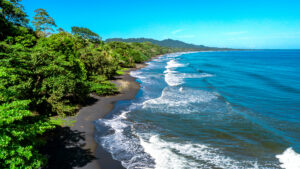
On the Caribbean coast specifically — in the communities of Puerto Viejo, Cahuita, Playa Chiquita, Punta Uva, and Manzanillo — that environmental identity is woven into the culture, the economy, and the buyer profile. The people who come here are not arriving despite the wilderness; they are arriving because of it. The Gandoca-Manzanillo Wildlife Refuge. The coral reefs. The sea turtle nesting grounds. The howler monkeys at dawn. These are not background features — they are the product.
This context matters for property investors because it shapes demand. The buyers and renters who are willing to pay the most in this market are, increasingly, those who are specifically seeking properties that honor the environment they have come to experience. A property that damages or contradicts that environment does not just carry an ethical cost — it carries a market cost.
The Green Premium: What the Data Shows in 2026
The market premium for sustainably built properties in Costa Rica is no longer anecdotal. As of 2026, credible industry data shows:
- Sustainable construction generates a price premium of 12% to 18% per square meter compared to conventional builds of equivalent size and location in tropical Costa Rica markets.
- Eco-certified and green-tagged vacation rental properties command up to 25% higher average daily rates on booking platforms — a premium that the market increasingly tags to off-grid capability, solar energy, and bioclimatic design.
- Sustainably built properties sell in 2 to 4 months on average, compared to significantly longer timelines for comparable conventional properties — reflecting stronger buyer demand at point of sale.
- Green buildings outperform conventional properties in occupancy rates, resale prices, and rental income — findings consistent with CoStar Group research on sustainable building performance across markets.
- Projections indicate that 50% of new residential developments in Costa Rica will incorporate sustainable building practices by the end of 2026, reflecting government incentives, buyer preferences, and market economics all moving in the same direction.
These are not lifestyle premiums — they are investment premiums. Buyers who understand this are building and buying differently as a result.
The Operating Cost Advantage: Where the Real ROI Lives
The sale price and rental rate premiums of eco-properties are the visible part of the financial case. The operating cost advantage is less visible — and often more powerful.
In a conventionally built tropical home or vacation rental, air conditioning is typically the single largest operating expense — frequently consuming 15% to 20% of gross rental income. In a properly designed bioclimatic property, the same function costs a fraction of that. Homes built with deep overhanging eaves, high ceilings, cross-ventilation, and local materials that manage humidity and heat without mechanical intervention can reduce cooling costs to as little as 3% of income. That difference flows directly to net cash flow.
Add renewable energy systems — solar panels, micro-hydro, or hybrid battery storage — and the operating profile of a well-built eco-property becomes genuinely distinctive:
- Certifiable bioclimatic construction can reduce total utility costs by up to 75% compared to conventional builds, through a combination of passive design and active renewable systems.
- Off-grid or grid-independent capability provides operational continuity during power outages — a meaningful practical advantage on the Caribbean coast, where tropical storms can disrupt grid service.
- Water independence through rainwater harvesting and grey water recycling systems reduces municipal utility reliance and positions a property well for areas where ASADA water access may be variable.
- Lower maintenance costs over time: quality natural and locally sourced materials like hardwoods, bamboo structural elements, and lime-based plasters are often more durable in the Caribbean’s high-humidity environment than imported conventional materials that require constant upkeep.
What Eco-Property Actually Means — and What It Doesn’t
One of the most important clarifications for buyers in this market is the difference between genuine sustainable construction and what is increasingly called greenwashing — properties marketed with eco language that have little substance behind it.
A common example on the Caribbean coast: container homes and basic modular structures marketed as eco-friendly because they use recycled materials. In practice, many of these builds lack the eaves, ceiling height, and passive ventilation design that makes a tropical home livable without constant mechanical cooling. Without those features, what looks sustainable on paper becomes an oven in the Caribbean climate — requiring more energy, not less.
Genuine eco-property on the Caribbean coast is defined by a combination of design, materials, systems, and land stewardship:
Bioclimatic Design
Homes designed specifically for the Caribbean climate — with extended roof overhangs, elevated construction that allows airflow beneath structures, high-pitched rooflines that exhaust heat, and orientation that captures prevailing breezes. These design choices reduce thermal load without mechanical assistance and represent the foundation of genuine tropical sustainability.
Local and Natural Materials
Sustainably harvested hardwoods, bamboo, local stone, lime plaster, and recycled materials sourced from Costa Rica reduce embodied carbon, support local economies, and — critically — perform better in the Caribbean’s salt air, high humidity, and heavy rainfall than many imported industrial materials.
Energy Independence
Solar photovoltaic systems, solar water heating, battery storage, and in some cases micro-hydro generation from on-property water sources. Properties with genuine off-grid or grid-hybrid capability command a specific market premium — the “off-grid” label alone is associated with up to 25% higher daily rental rates in eco-tourism markets.
Water Systems and Land Stewardship
Rainwater collection, grey water recycling, composting systems, and on-property reforestation or conservation zones. Properties adjacent to or incorporating functioning natural ecosystems — forest corridors, streams, and wildlife habitat — carry both ecological and market value in a region where environmental integrity is the core attraction.
Certification: The ICT’s CST Program and What It Means for Investors
Costa Rica’s Instituto Costarricense de Turismo (ICT) administers the Certification for Sustainable Tourism (CST) — a nationally recognized, internationally respected green rating system for tourism businesses and properties. The CST rates properties on a five-leaf scale across four dimensions: the relationship with the physical-biological environment, internal systems for waste and resource management, service management aligned with sustainable tourism, and community and socioeconomic engagement.
For investors considering eco-lodges, boutique hotels, vacation rental operations, or community-based tourism projects on the Caribbean coast, CST certification serves multiple functions:
- It provides verified, third-party validation of a property’s sustainability claims — distinguishing genuine eco-properties from greenwashed alternatives in the market
- It improves discoverability on booking platforms that filter for certified sustainable properties — a segment of demand that is growing fast among international eco-travelers
- It supports access to government-backed incentive programs and, in some cases, expedited permitting processes for construction and development
- It creates a defensible premium when the property is eventually resold — buyers of eco-tourism businesses and rental properties place significant weight on verified certifications
The Caribbean Coast Advantage: Why This Market Is Uniquely Positioned for Eco-Property Value
The Pacific coast of Costa Rica — Guanacaste, the Nicoya Peninsula, the Central Pacific — has a longer, more developed history with eco-tourism. It also has a far higher level of conventional development, infrastructure, and price. The Caribbean coast is at a different moment in its trajectory — and that moment creates specific opportunities for eco-property investors.
- Land prices remain significantly more affordable than comparable Pacific coast communities — meaning eco-construction can be undertaken here at a total project cost that would be impossible in Nosara, Santa Teresa, or Manuel Antonio. A buyer who might stretch to afford a modest conventional property in those markets can build a genuinely high-quality, sustainably designed home on the Caribbean for the same budget.
- The eco-tourist and digital nomad demographic that dominates Caribbean coast visitation is also the demographic most willing to pay the green premium on vacation rentals. These are not buyers searching by price — they are filtering by values, certification, and environmental credentials. A property that speaks that language commands their business.
- The Gandoca-Manzanillo Wildlife Refuge, Cahuita National Park, and the surrounding biodiversity corridors create a natural environment that actively increases the desirability — and therefore the rental premium — of properties positioned within or adjacent to it.
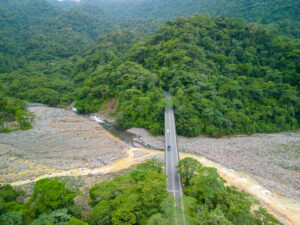
- Route 32’s completion in December 2025 has made the Caribbean coast significantly more accessible from San José — bringing a new wave of buyers and renters who might have previously looked only at the Pacific. Among that incoming wave, eco-conscious buyers and eco-tourism operators are well represented.
Buying an Eco-Property on the Caribbean Coast: What to Evaluate
For buyers evaluating eco-properties — whether completed homes, eco-lodges, or raw land for sustainable construction — the following factors determine whether a property genuinely delivers the green premium or merely claims it:
- Design intentionality: Is the structure genuinely bioclimatic — built for the Caribbean climate — or does it rely on mechanical systems to compensate for poor design? Ask about ceiling heights, roof pitch, overhang depth, and cross-ventilation strategy.
- Energy systems: What renewable energy infrastructure is in place or planned? Solar, battery storage, solar water heating, and grid-hybrid or off-grid capability are the features that drive both rental premiums and operating cost reductions.
- Water independence: Does the property have rainwater collection, a well, or documented ASADA access? What grey water and wastewater management systems are in place? These are regulatory requirements in many zones and market differentiators in all of them.
- Material provenance: Where do the primary construction materials come from? Local and natural materials typically outperform imports in both environmental footprint and long-term performance in the Caribbean’s climate.
- Certification status: Does the property hold or is it eligible for ICT CST certification, or any other recognized sustainable building or tourism certification? For income-producing eco-properties, certification is increasingly a baseline expectation among the highest-paying guest segments.
- Land stewardship: What percentage of the property is maintained as natural habitat, garden, or forest? Conservation easements, reforestation programs, and wildlife corridor contributions add both ecological and market value in this region.
Frequently Asked Questions: Eco-Property on the Caribbean Coast
Does eco-property cost more to build than conventional construction?
In some cases, upfront construction costs are higher — particularly for high-quality renewable energy systems and certified sustainable materials. However, the premium is often recovered quickly through lower operating costs and higher rental rates, and the resale premium typically more than justifies the initial investment. For buyers building on land in the Caribbean corridor, engaging a local architect or builder experienced in bioclimatic tropical design is the most important first step.
Is eco-tourism on the Caribbean coast seasonal?
The Caribbean coast of Costa Rica has a distinct rain pattern from the Pacific — while the Pacific has a pronounced dry season, the Caribbean receives rainfall year-round with a slightly drier spell from March to May and September to October. In practice, this means the Caribbean eco-tourism market is less sharply seasonal than the Pacific, with consistent visitor traffic driven by wildlife watching, surfing, diving, and cultural tourism throughout the year.
Can I build a new eco-property near the wildlife refuge or national park?
Proximity to protected areas is a market asset — but construction within or directly adjacent to protected zones requires careful environmental permitting, including review by SETENA (Costa Rica’s environmental impact agency) and compliance with the relevant protected area’s management plan. Properties near but outside protected zones, on titled land with appropriate zoning, are generally developable with proper permits and plans. Your attorney and architect should be involved before any land is purchased for development near a protected area.
What types of eco-property investment work best on the Caribbean coast?
The strongest performers are vacation rental homes and casitas with genuine off-grid or hybrid energy systems, targeted at the eco-traveler and digital nomad segments. Boutique eco-lodge operations — four to twelve units with a curated natural experience and CST certification — also perform well in communities like Punta Uva and Manzanillo where the environment itself draws a premium guest. At the land level, lots with significant tree canopy, creek or river access, and wildlife corridor adjacency are increasingly sought after as the foundation for eco-development.
How Coldwell Banker Caribe Helps Eco-Minded Buyers Find the Right Property
We have been operating on Costa Rica’s Caribbean coast long enough to understand the difference between genuine eco-property and the appearance of it. We know which lots carry the natural features that make sustainable development viable. We know which existing properties are built to bioclimatic standards that will actually perform in the Caribbean climate. And we know which listings are using eco language without substance behind it.
For eco-minded buyers, we offer:
- Access to verified eco-properties and sustainably built homes throughout the Caribbean corridor — from Puerto Viejo to Manzanillo
- Honest assessment of any property’s genuine sustainable features versus its marketing claims
- Connections to local architects, builders, and contractors experienced in bioclimatic tropical construction for buyers planning to build
- Guidance on land selection for buyers looking to develop — identifying lots with the natural features, zoning, and site characteristics that support high-quality sustainable construction
- Market context on rental income potential, occupancy trends, and the green premium in specific Caribbean communities
Conclusion: In This Market, Green Is the Smart Money
The Caribbean coast of Costa Rica has always been a place where the environment was the point. What has changed in 2026 is that the financial markets have caught up with that reality. Eco-properties — genuinely, substantively built to work with the tropical environment rather than fight it — are now delivering measurable premiums in sale price, rental income, time-on-market, and operating efficiency.
For buyers who care about both their values and their returns, the Caribbean coast in 2026 offers a rare alignment: a region where the ethical choice and the financial choice point in exactly the same direction.
Browse our current Caribbean coast listings at coldwellbankercaribe.com, or contact our team to discuss eco-property options, sustainable build sites, and the investment case for green construction in Talamanca. We are ready to help you find the right piece of this remarkable coast.
📞 Contact Coldwell Banker Caribe: coldwellbankercaribe.com